Skip to content

Videos

Legislative Drafting

2026 | Webinar — Legislative Drafting and the Environment: From Backyards to Biomes

Date: June 4, 2026
Location: Online


OVERVIEW

This webinar will explore the evolving landscape of legislative drafting in the environmental context, highlighting how federal, provincial, and municipal jurisdictions navigate overlapping authorities and responsibilities. Presenters will identify recurring drafting challenges, and discuss best practices and mitigation strategies for responding.

Through real‑world examples and thematic discussion, attendees will leave with tools and perspectives to support drafting effective, adaptive, and principled environmental legislation.


SPEAKERS & MODERATOR

Speakers:

Kristi Cairns, Legislative Counsel, Office of Legislative Counsel, Legislative Assembly of Ontario

Kristi Cairns is a legislative drafter with deep experience at the intersection of environmental policy and public law. After completing a degree in environmental engineering, she earned her law degree from Dalhousie University in 2001, along with a Certificate in Marine and Environmental Law. She was called to the bar in 2002 and began her legal career practicing pharmaceutical patent litigation at Gowlings, where she spent two years before moving into public service.

Kristi then joined the legislative drafting team within the Legal Services Branch of Ontario’s Ministry of the Environment, Conservation and Parks. Over the next 16 years, she worked as instructing counsel on a wide range of complex legislative and regulatory initiatives, including emissions trading, administrative penalties, spills, air pollution, the cosmetic pesticides ban, pollinator health, Drive Clean, and the modernization of approvals.

In January 2020, Kristi joined the Office of Legislative Counsel, moving to the other side of the drafting table. In her current role, she works on a broad array of bills, regulations, and motions for several ministries, including the Ministry of the Environment, Conservation and Parks, bringing a practical, policy‑informed perspective to legislative drafting.

Andrea A. Cole, Lawyer, Law Department, The City of Calgary

Andrea Cole practices administrative law in Alberta as in-house counsel with The City of Calgary, a position she has held since 2016. Her practice includes drafting municipal bylaws, policy review, and legislative interpretation. A graduate of the University of Toronto Faculty of Law, Andrea was first called to the bar in Ontario in 2010. After articles, she began her law career within Ontario’s Ministry of the Attorney General (first at Crown Law Office-Civil Law and then with Social Justice Tribunals Ontario).

Andrea has co-authored two articles on administrative law that were published in the Canadian Journal of Administrative Law & Practice and the Canadian Bar Review. Along with co-counsel, Andrea represented The City of Calgary as an intervener before the Supreme Court of Canada in the Auer appeal that addressed judicial review of subordinate legislation.

Thomas Cormie, Senior Counsel, Legislative Services Branch, Department of Justice Canada

Thomas Cormie was raised in Whitehorse and holds BA, BCL and LLB degrees from McGill University and an MA from Columbia University in the City of New York. Thomas articled at Justice Canada’s Montréal offices in 2011, and is a member of the Barreau du Québec.

Thomas conducted judicial review litigation before the Federal Court until 2016, then moved to Ottawa to begin work as legislative counsel in Justice’s Headquarters Regulations Section. Since arriving in Ottawa, Thomas has on two occasions stepped away from drafting regulations to work on assignment providing advice on various administrative law matters, as well as on other matters related to legislative drafting and interpretation.

Although Thomas may be called upon to prepare regulations sponsored by most federal ministers, Thomas has particular responsibilities in assisting Environment and Climate Change Canada’s regulatory initiatives.

Moderator : 

Jaimie Graham, Legal Counsel, Alberta Utilities Commission

Jaimie Graham is legal counsel for the Alberta Utilities Commission. She holds a LL.M. from the University of Calgary, focusing on natural resources, energy, and environmental law, and has participated in the University of Victoria’s Indigenous Law Research Methodologies Intensive. Her work experience includes roles with the Government of Canada, the Yukon Utilities Board, and the Alberta Electric System Operator.


CPD HOURS

Participation in this program is accredited in provinces where CLE requirements for lawyers are mandatory.

  • Total: 1h
  • No EDI hours


FEES

Categories

Fees

CIAJ Members Free
Non-Members $75
Students (CIAJ Members) Free
Students (Non-Members) $25


Webinar | Legislative Drafting and the Environment: From Backyards to Biomes

2024 | Legislative Drafting Conference (2024 Edition)

Date: September 16-18, 2024
Location: Ottawa & Online


OVERVIEW

CIAJ’s biennial Legislative Drafting Conference tackles the most important challenges in modern legislation.

This 22nd Edition (in-person and online) continues a long tradition of exploring the many facets of legislative drafting with a particular focus on the Canadian context. The 2024 conference will bring together practitioners and academics to discuss various aspects of the work of preparing legislative texts. The conference will address a broad range of topics including practical challenges drafters face in their work, developments in statutory interpretation and questions of diversity and inclusion in statutes. The 2024 conference will also pay tribute to the late Ruth Sullivan who had a profound influence on the field of legislative drafting.

PROGRAM


GUEST SPEAKERS

Guest of Honor

The Honourable Justice David W. Stratas, from the Federal Court of Appeal, will be present at the reception at the Supreme Court of Canada, which will take place at the end of the first day (Monday, September 16, 2024).

The Honourable Justice David W. Stratas, Federal Court of Appeal

LL.B. (Queen’s University, 1984); B.C.L. (Oxford University, 1986); LL.D. (Queen’s University, 2012, honoris causa). Born in Toronto, Ontario. Law clerk to Justice Bertha Wilson of the Supreme Court of Canada (1986-1987). Called to the Bar of Ontario (1988). Litigation partner in firms in Toronto, Ontario. Fellow of the American College of Trial Lawyers (2008). Appointed Special Advocate by the Minister of Justice (2008). Adjunct member, Faculty of Law, Queen's University (1994 to the present), winning multiple faculty teaching awards. Instructor and presenter at over 60 judicial education sessions across Canada, most frequently in the area of administrative law. Author of over 200 articles or conference papers on various legal topics, particularly in the areas of administrative law, constitutional law, and legal writing. Appointed Judge of the Federal Court of Appeal, and a member ex officio of the Federal Court on December 11, 2009. Appointed Judge of the Court Martial Appeal Court of Canada, May 3, 2012. Acting Chief Justice from July to November 2023.


CPD Hours: 

  • Total: 11h30

For provinces where professional hours apply:

  • Total: 10h
  • EDI hours: 1h30

Participation in this program is accredited in provinces where CLE requirements for lawyers are mandatory.


FEES

Per Day:

  • CIAJ Members: $200
  • Non-Members: $275
  • Students: $25

Full Conference:

  • CIAJ Members: $475
  • Non-Members: $625
  • Students: $75


Legislative Drafting Conference (2024 Edition)

2024 | Webinar: The (Dis)Connect between Legislative Drafting and Statutory Interpretation: Perspectives from Three Branches of Government

Date

Tuesday, November 26, 2024

OVERVIEW

Legislative drafting is viewed as a specialized area of law that requires particular education, skills and experience. A legislative drafter’s legal opinion is that the text will have a certain legal effect when the relevant interpretative provisions are considered. To this end, professional legislative drafters follow specific drafting conventions, styles and practices.

However, drafting conventions are not well known by legal professionals outside of the specialized drafting community, nor are they commonly referenced by parties in court or in judicial reasons. This raises questions regarding their value in the statutory interpretation exercise, and what more could be done to increase familiarity with drafting conventions to those outside the professional legislative drafter community.

Further, principles of statutory interpretation have developed with reference to the way that drafters and drafting offices operate; however, contemporary realities may call reliance on some of these principles into question.

In this webinar, professionals from three branches of government discuss the theory and realities of drafting and statutory interpretation, and provide recommendations regarding how they can be better reconciled.

Panelists:

  • Gabriela Dedelli, Parliamentary Counsel, Legislative Assembly of Ontario
  • The Hounourable Justice Gareth Morley, Judge of the Supreme Court of British Columbia in Victoria
  • Christina Wasyliw, Deputy Legislative Counsel & General Counsel, MB Justice

Moderator: Jaimie Graham, Legal Counsel, Alberta Utilities Commission

RESOURCE: Legislative Drafting in Statutory Interpretation: A Plea for Recognition – Gabriela Dedelli

Fees
CIAJ Members: $40
Non-members: $55


Webinar | The (Dis)Connect between Legislative Drafting and Statutory Interpretation: Perspectives from Three Branches of Government

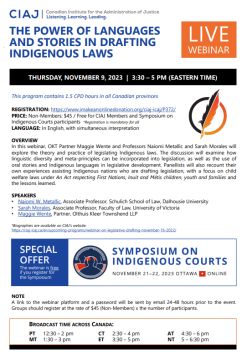
2023 | The Power of Languages and Stories in Drafting Indigenous Laws

Program

Date

Thursday, November 9, 2023

90-minute webinar

This program contains 1.5 CPD hours in all Canadian provinces

Theme

In this webinar, OKT Partner Maggie Wente and Professors Naiomi Metallic and Sarah Morales will explore the theory and practice of legislating Indigenous laws. The discussion will examine how linguistic diversity and meta-principles can be incorporated into legislation, as well as the use of oral stories and Indigenous languages in legislative development. Panellists will also recount their own experiences assisting Indigenous nations who are drafting legislation, with a focus on child welfare laws under An Act respecting First Nations, Inuit and Métis children, youth and families and the lessons learned.

Speakers

Fees
CIAJ Members: Free
Non-members: $45


2023  I  Legislative Drafting Webinar on The Power of Languages and Stories in Drafting Indigenous Laws

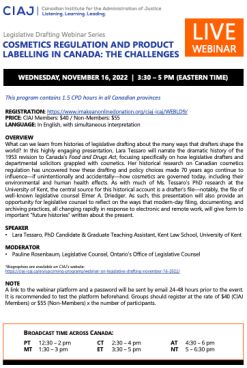
2022 | Cosmetics Regulation and Product Labelling in Canada: The Challenges

Program

Date

Wednesday, November 16, 2022

90-minute webinar

This program contains 1.5 CPD hours in all Canadian provinces

Theme

What can we learn from histories of legislative drafting about the many ways that drafters shape the world? In this highly engaging presentation, Lara Tessaro will narrate the dramatic history of the 1953 revision to Canada’s Food and Drugs Act, focusing specifically on how legislative drafters and departmental solicitors grappled with cosmetics. Her historical research on Canadian cosmetics regulation has uncovered how these drafting and policy choices made 70 years ago continue to influence—if unintentionally and accidentally—how cosmetics are governed today, including their environmental and human health effects. As with much of Ms. Tessaro’s PhD research at the University of Kent, the central source for this historical account is a drafter’s file—notably, the file of well-known legislative counsel Elmer A. Driedger. As such, this presentation will also provide an opportunity for legislative counsel to reflect on the ways that modern-day filing, documenting, and archiving practices, all changing rapidly in response to electronic and remote work, will give form to important “future histories” written about the present.

Speaker

Lara Tessaro is a socio-legal researcher and historian of law, gender, and toxicity in twentieth-century Canada. Currently, she is pursuing a PhD in law at the University of Kent in the United Kingdom, funded by a Vice Chancellor’s research scholarship and a SSHRC doctoral fellowship. Her thesis explores histories of Canadian cosmetic regulation, with particular focus on the legal practices, ideas, and events that have given shape to cosmetic product labelling. In 2018, she attained a research-based LL.M. degree from Osgoode Hall Law School, which nominated her thesis for the York University thesis prize. From 2004 to 2017, Lara practiced law in BC and Ontario, primarily in environmental and administrative law. For much of that period, she worked as a staff counsel at Ecojustice Canada (formerly Sierra Legal Defence Fund), where she developed and advanced test case litigation on behalf of environmental organizations, First Nations, and scientists. She has also served as junior commission counsel to two federal public inquiries, the Commission of Inquiry into the Actions of Canadian Officials in Relation to Maher Arar (the Arar Inquiry), and the Commission of Inquiry into the Decline of Sockeye Salmon in the Fraser River (the Cohen Inquiry).

Moderator

  • Pauline Rosenbaum, Legislative Counsel, Ontario’s Office of Legislative Counsel

Pauline attended law school at the University of Toronto and articled as a judicial research clerk at the Ontario Superior Court of Justice. She joined Ontario’s Office of Legislative Counsel in 2010. Before joining OLC, Pauline worked as counsel at the Ontario Human Rights Commission, at the Office of the Chief Justice of the Ontario Superior Court of Justice and at a speciality legal aid clinic serving low-income seniors. Pauline also has experience working in the heath regulatory sector at the Ontario College of Pharmacists and the Royal College of Dental Surgeons of Ontario.

Fees
CIAJ Members: Free
Non-members: $40


2022  I  Legislative Drafting Webinar on Cosmetics Regulation and Product Labelling in Canada: The Challenges

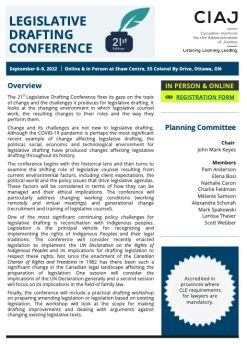
2022 | Legislative Drafting Conference (21st Edition)

Program

Date (Online & In Person in Ottawa)

September 8-9, 2022

Program accredited in provinces where CLE requirements for lawyers are mandatory.

Theme

The 21st Legislative Drafting Conference fixes its gaze on the topic of change and the challenges it produces for legislative drafting. It looks at the changing environment in which legislative counsel work, the resulting changes to their roles and the way they perform them.

Change and its challenges are not new to legislative drafting. Although the COVID-19 pandemic is perhaps the most significant recent example of change affecting legislative drafting, the political, social, economic and technological environment for legislative drafting have produced changes affecting legislative drafting throughout its history.

The conference begins with this historical lens and then turns to examine the shifting role of legislative counsel resulting from current environmental factors, including client expectations, the political world and the policy issues that drive legislative agendas. These factors will be considered in terms of how they can be managed and their ethical implications. The conference will particularly address changing working conditions (working remotely and virtual meetings) and generational change (recruitment and training of legislative counsel).

One of the most significant continuing policy challenges for legislative drafting is reconciliation with Indigenous peoples. Legislation is the principal vehicle for recognizing and implementing the rights of Indigenous Peoples and their legal traditions. The conference will consider recently enacted legislation to implement the UN Declaration on the Rights of Indigenous Peoples and its implications for drafting legislation to respect these rights. Not since the enactment of the Canadian Charter of Rights and Freedoms in 1982 has there been such a significant change in the Canadian legal landscape affecting the preparation of legislation. One session will consider the implications of the UN Declaration generally and a second session will focus on its implications in the field of family law.

Finally, the conference will include a practical drafting workshop on preparing amending legislation or legislation based on existing legislation. The workshop will look at the scope for making drafting improvements and dealing with arguments against changing existing legislative texts.

Planning Committee

Chair

  • John Mark Keyes

Members

  • Pamela Louise Anderson
  • Catherine Beaudoin
  • Elena Bosi
  • Nathalie Caron
  • Charlie Feldman
  • Melanie Samson
  • Alexandra Schorah
  • Mark Spakowski
  • Lerissa Thaver
  • Scott Webber

Fees

Per Day:
CIAJ Members: $200
Non-members: $275
Students (enrolled full-time at Canadian universities): $25

Related PowerPoint presentations and papers are available in the library under "documentation."


2022 I 2022 Legislative Drafting Conference (21st Edition)